
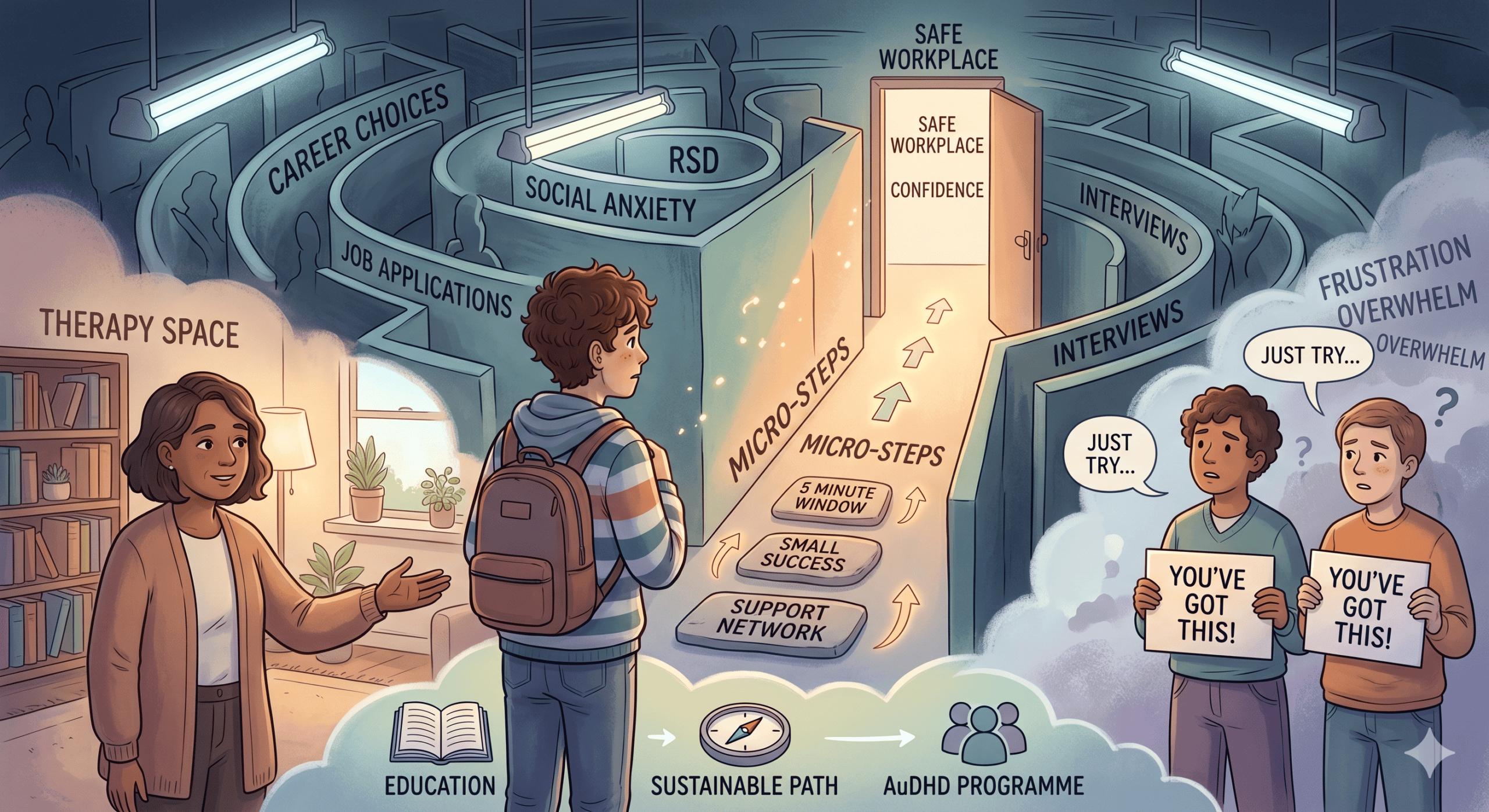
Moving from education to work is one of life’s biggest transitions. It can feel overwhelming when the prescribed pathway you have followed for years suddenly disappears, and you are faced with a maze of choices and possibilities.
For those of you who are neurodivergent and inclined to overthinking, this can feel especially daunting. Sometimes it is so overwhelming that you may feel you want to give up before you have even begun.
This is a topic I feel deeply passionate about, both through my personal experience and my professional work as a therapist supporting young adults as they take their first steps into the workplace.
The Invisible Barriers to Entry
What sounds like a simple instruction, “just apply for jobs,” can quickly become overwhelming when you are faced with choosing a career path, writing applications, and navigating interviews.
If you experience social anxiety, even the thought of interviews can feel unbearable. For those who live with Rejection Sensitivity Dysphoria (RSD), the possibility of not hearing back or being turned down can feel shattering.
When all of this is happening at once, it’s understandable that the process doesn’t just feel difficult; it can feel impossible to begin at all. Getting started may also be difficult if you are carrying memories of past education or work environments that didn’t feel safe or accommodating.
This isn’t just about confidence; it’s also about how your nervous system respond to the world around you.
Many workplaces are designed for efficiency rather than comfort. For neurodivergent individuals, this can create an additional layer of challenge. Sensory overload and fatigue can often be triggered by:
- Open-plan offices
- Constant background noise
- Harsh fluorescent lighting
- Demands that drain your social battery
In my practice, I hear from so many young adults who feel guilty for struggling with these things. But these aren’t personal failings; they are real, physical barriers that require real strategy and support to navigate.
Navigating Your Support Network
It can really help to know what kind of support to expect from the people around you. Your friends and family may genuinely want to help but are not always sure how to do it in a way that feels right for you. Perhaps they say things that, despite their best intentions, end up triggering feelings of frustration, anxiety, and/or overwhelm. Indeed, what they perceive to be easy may not be easy for you!
It may be difficult for them to empathise with your fears. Sometimes, their well-meaning words of encouragement can leave you feeling even more alone, as if they don’t quite understand how real or intense your worries are. You might end up feeling defeated, unable to “just get a job,” worrying that you are being left behind while everyone else seems to be moving forward.
What might help is communicating to your well-meaning supporters exactly what you need from them.
- Maybe you want them to give you more space, while still being willing to offer a compassionate ear when things feel hard.
- Perhaps you would like them to be more proactive and help you break things into smaller, more manageable steps, focusing on what feels possible right now rather than all the “what ifs” that can spiral in your mind.
Taking Micro-Steps
Managing the transition might mean doing something small but practical, like updating your CV, finding one job that seems interesting, or practicing how to ask for the adjustments that could make work feel more comfortable for you. These small steps can make things feel less overwhelming, and they’re a powerful way to build your confidence bit by bit.
An immediate and achievable goal might be what I often call “The Five-Minute Window.” You commit to looking at one job board for just five minutes. When the timer goes off, you stop, even if you’re mid-sentence. This proves to your nervous system that you are in control and that the task has a concrete finish line.
How I work with my clients
In therapy, as a first step, I work to create a safe, understanding space where my clients feel truly heard. From there, we work collaboratively to identify the barriers, both internal and external, that make the transition to work so difficult.
Together, we focus on small, meaningful steps that rebuild confidence, self-trust, and hope. Over time, this approach helps them not only to enter the workplace but to thrive within it, on their own terms.
Looking for More Support?
The move from education into adult life isn’t simply about finding a job. For many AuDHD young adults, it’s about learning how to navigate a world that often feels confusing, overwhelming, and exhausting.
I’m currently creating a small-group online programme for AuDHD young adults (18–30) who want support building confidence, understanding their needs, managing overwhelm, and creating a sustainable path forward.
If you’ve ever felt as though you’re capable of more than you’re currently able to show, or that you’re constantly working harder than everyone else just to keep up, this programme is being designed with you in mind.
If you’d like to hear more when details are released, join my interest list.
References:
- https://www.fenews.co.uk/exclusive/neurodiverse-youth-in-development-and-transition-and-how-to-help-them/
- https://psychiatryonline.org/doi/full/10.1176/appi.ps.201300201
- https://quietconnections.co.uk/blog/social-anxiety-workplace/
- https://www.youngminds.org.uk/young-person/blog/dealing-with-social-anxiety-at-work/